Showing posts with label Irish. Show all posts

Monday, February 20, 2012

This Could Be Gre--No, It's Probably Gonna Suck

So I come across this today:
Michael Fassbender and screenwriter Ronan Bennett are developing a feature film about the legendary Celtic warrior Cuchulain, with Fassbender set to play the leading role.

Cuchulain is the central character in the Ulster Cycle, an epic series of Old Irish legends that date from around the 8th century.

Set in the northern part of Ireland, the saga relates the story of the Ulaid tribe headed by King Conchobar, and particularly its conflict with the rival Connachta tribe led by Queen Mebh.

The most prominent figure in the legends is Conchobar's nephew Cuchulain, who has semi-divine ancestry and superhuman fighting skills. In the most famous story, known as the Cattle Raid of Cooley, he is the only man capable of resisting the vast army sent by Medb to steal Conchobar's prize white bull.

Now, this isn't meant to be a knock on Fassbender or Bennett, but it's not as if there've been many successful adaptations of mythology lately--not the dreadful remake of Clash of the Titans, nor the inexplicable Immortals, and especially not 2004's laugh-fest King Arthur.

I'm always wary of adapting mythology--which ultimately was (and still is) someone's religion. Usually in these big-budget adaptations, the gods are an evil to be defeated by mortals (which is an ugly bastardization of the meanings of those myths), or they're written out altogether (as in the otherwise watchable Troy). I can easily see this as being a "defeat the gods" film, given that the Morrigan is an antagonist, while Lugh, Cuchulain's divine father, could easily be ignored or forgotten. Really, the only film that hasn't been automatically dismissive of gods was Thor, and they aren't exactly gods, but aliens with god-like abilities.

And while ancient stories are all the rage, it's rare they aren't big, bloated, painful messes. I rather liked Tristan and Isolde--it wasn't a great film, but because the action was smaller and the conflict personal, it wasn't a terrible film, either. I dread to think of the Cattle Raid of Cooley being turned into 300.

On the other hand, the last film I saw that delved into Irish myth and history was the absolutely fantastic Secret of Kells, so it's not as if the task is impossible.

Wednesday, February 1, 2012

Rethinking Imbolc

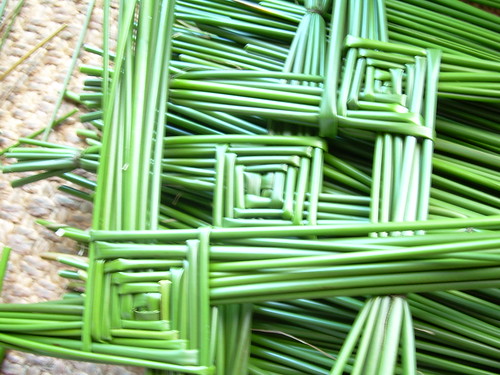
Weaving St. Brigit's Cross from JustWeaving

Today is the feast of St. Brigit, which coincides with Imbolc, a Ráithí Fírinneacha na Bliana--"One of the True Quarters of the Year" (along with Samhain, Beltane, and Lughassadh, and as opposed to the solstices and equinoxes). It's the first day of spring by the Irish reckoning, and given that it's in the mid-sixties here in Philly, it certainly feels like spring.


Groundhog's Day is definitely related to Imbolc, and if that damned groundhog says we have six more weeks of winter, when we haven't had even one week, it's time to string up the rat.

Anyway, I wrote a paper on the Irish holiday of Imbolc; here's a taste:

While Imbolc is undoubtedly a feast of spring, and a feast celebrating Brigit, there is, I think, a third element to the feast which is sometimes overlooked—it is likely that Imbolc is a feast of purification, and perhaps represents a longer period of purification, analogous to several other Indo-European and even Christian festivals. Moreover, this feast of purification is intimately bound up with the holiday’s other meanings honoring spring and Brigit—that all three are important to understanding the origins of Imbolc. 
...
The four main feasts of the Celtic calendar—commonly known by their Irish names Samhain, Imbolc, Beltane, and Lughnassadh—when their themes are examined, form a series of corresponding concepts. Samhain is a feast of winter, death, and the ancestors, while Beltane is a feast of summer, sexuality, and fertility.

If Hamp is right, and Imbolc is analogous to the February period of purification found in Roman and Christian tradition, then perhaps Imbolc, like Lughnassadh, was a period and not a single day. It is currently impossible to prove that the pre-Christian Irish observed Imbolc as such a period, but as we have seen, we have analogous ideas in neighboring cultures, and even a Gaulish month called “purification” which falls around the time of February


You can read the whole thing at Scribd

Monday, August 1, 2011

Happy Lughnassadh/Lammas!

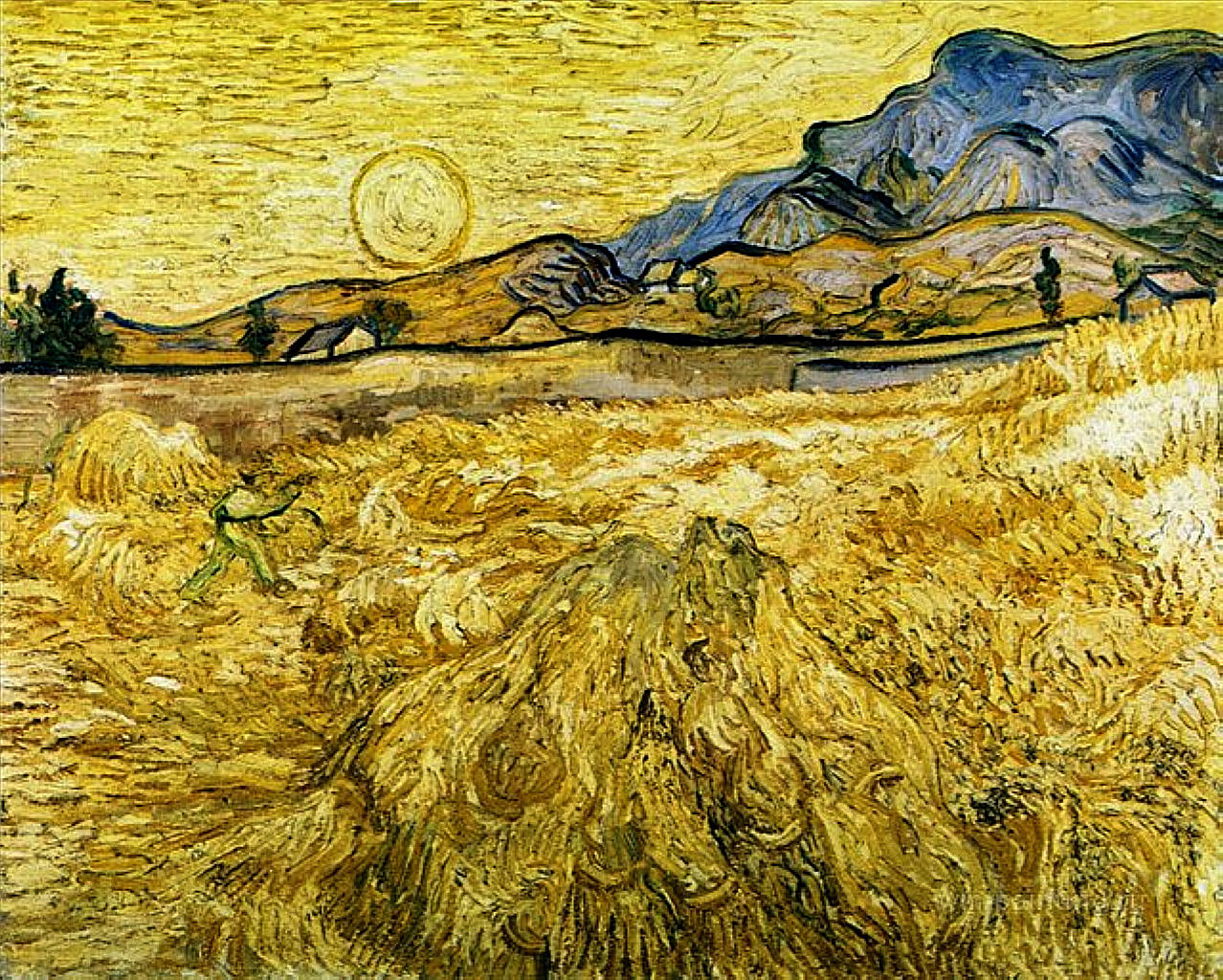
Wheat Field with Reaper and Sun - Van Gogh

 August 1st on the traditional Irish calendar marks Lughnassadh--"the assembly of Lugh", wherein Lugh of the Long Arm, the Many-Skilled God of All Arts, is honored, along with his foster-mother Tailltiu, who first tilled the land in order to plant crops.

§59. Tailltiu daughter of Mag Mor king of Spain, queen of the Fir Bolg, came after the slaughter was inflicted upon the Fir Bolg in that first battle of Mag Tuired to Coill Cuan: and the wood was cut down by her, so it was a plain under clover-flower before the end of a year. ...and Cian son of Dian Cecht, whose other name was Scal Balb, gave her his son in fosterage, namely Lugh, whose mother was Eithne daughter of Balar. So Tailltiu died in Tailltiu, and her name clave thereto and her grave is from the Seat of Tailltiu north-eastward. Her games were performed every year and her song of lamentation, by Lugh. With gessa and feats of arms were they performed, a fortnight before Lugnasad and a fortnight after: under dicitur Lughnasadh, that is, the celebration (?) or the festival of Lugh.
So what's so great about Lugh? Why's he so important? We can be relatively confident he was worshiped in places like Iberia (where we have inscriptions to "the Lugoves", which means "the Lughs"), Gaul (with the city of Lugdunum "fort of Lugh", today called Lyon), Britain (where the story of Lleu is set down in the fourth branch of the Mabinogi), and Ireland (where we have lots of stories about him), and so on. So why is today, the harvest day, the day the Celts worshipped Lugh?

Simple--not only was he the MacGyver of deities, he got the secrets of harvesting food from the king of the Fomoraig, the Bad Guys of Irish mythology:

Thereafter Lugh and his comrades found Bres son of Elotha unguarded. He said:"It is better to give me quarter than to slay me."

"What then will follow from that?" said Lugh

"If I be spared," says Bress, "the cows of Erin will always be in milk."

"I will set this forth to our wise men," said Lugh.

So Lugh went to Maeltne Mor-brethach , and said to him: "Shall Bress have quarter for giving constant milk to the cows of Erin?" " He shall not have quarter," said Maeltne; "he has no power over their age or their offspring, though he can milk them so long as they are alive."

Lugh said to Bress: "That does not save thee: thou hast no power over their age and their offspring, though thou canst milk them. Is there aught else that will save thee, O Bres?" said Lugh.

"There is in truth, Tell thy lawyer that for sparing me the men of Ireland shall reap a harvest in very quarter of the year."

Said Lugh to Maeltne: "Shall Bres be spared for giving the men of Ireland a harvest of corn every quarter?"

"This has suited us," said Maeltne: "the spring for ploughing and sowing, and the beginning of summer for the end of the strength of corn, and the beginning of autumn for the end of the ripeness of corn and for reaping it. Winter for consuming it"

"That does not rescue thee," said Lugh to Bres; "but less than that rescues thee."

"What?" said Bres.

"How shall the men of Ireland Plough? How shall they sow? How shall they reap? After making known these three things thou wilt be spared."

"Tell them, said Bres, that their ploughing be on a Tuesday, their casting seed into the field be on a Tuesday, their reaping on a Tuesday." So through that stratagem Bres was let go free.

The story of Lugh wrestling the secrets of agriculture--in other words, making sure people can eat--from Bres is paralleled in Christian texts wherein St. Patrick does battle with Crom Dubh. The theme of St. Patrick winning food has many versions, the oldest of which is found in the vita found in the Book of Armagh, and other variants, as described by Máire Mac Neill:

In general, the folk-legend has the following plot: the saint comes to the distrct and begins t build a church; in a time of food-shortage he asks the pagan magnate for food for his workmen; the pagan has a fierce bull which kills all who approach it, and he offers the bull to the saint in the ope that it will kill him; the bull, however, submits quietly to being taken and slaughtered; the bull's flesh is eaten by the saint's company but the saint enjoins that the hid and bones be carefully kept; the pagan, enranged at the loss of his bull and the failure of his plan, asks the saint to give back the bull; the saint has the bones and hid put together, and the bull rises to life.

The Festival of Lughnasa, pg 393
Mac Neill's book is the go-to source on the holiday, and if you can get a copy of it, grab it--it's often very hard to find.

And it wasn't just the Irish: the medieval English knew the day as hlafmæssen-dæg, literally "loaf-mass day"1, the feast of first fruits, when the harvest first ripens. The cereal crops come in, and are turned into such wonderful things as bread, beer, cakes, whiskey, Cheerios... Well, I think Cheerios. Pretty sure.

Anyway, the word eventually became Lammas, and was the time of year for the Lammas fairs, especially the Ould Lammas Fair, held in Co. Antrim, Ireland, for the last four hundred years.  Mac Neill maintains that Lammas--particularly given its timing on August 1st ultimately comes from Lughnassadh, and I really don't see any reason to contradict her.

In Wales, the day is called "Calan Awst", which is rather straightforward, meaning "First Day of August". And as far as I know, there's no connection made between Lleu and August 1st. Indeed, very little of the day seems to survive in Wales; Mac Neill mentions that in the nineteenth century, people would gather on the Breckon Beacons, heading for Llyn y Fan Fach, as described by Sir John Rhys, where the Lady of the Lake would make an appearance.

But Lugh shows up in Wales as well, as Lleu, the put-upon son of Aranrhod, cursed by his mother, raised in isolation by Gwydion, murdered by his wife's lover, but ultimately triumphs over all of it to become king of Gwynedd. It's unfortunate that we only have scraps left to us in the Mabinogi and the poems of Taliesin to piece together Lleu's story.

So today, Loaf-Mass-Day, the Festival of Lugh, and oddly enough the birthday of Clau-Clau-Claudius in the city of Lugdunum, I baked a loaf of beer bread, and will enjoy eating it, preferably with a bottle of beer homebrewed by a friend of mine.


On that note, I leave you with "John Barleycorn"; I wish I could find the Fairport Convention version, but Traffic will have to do.


NOTES

1. Just as Christ-mass is now Christmas, Loaf-Mass became Lammas.

Saturday, March 12, 2011

Was Hamlet Irish?

The Guardian has an article about the recently-published theories of Dr Lisa Collinson, a professor of medieval Scandinavian at Aberdeen, wherein Hamlet's name is traced to a medieval Irish story; she sums up her ideas at the Oxford University Press blog:
[I]n an article published online last week in the OUP journal Review of English Studies, I have set out my own  – no doubt even less perfect – theory, which I hope will be of as much interest to artists of various kinds as to scholarly specialists.

In this new article, I conclude that Hamlet probably came ultimately from Gaelic Admlithi: a name attached to a player (or ‘mocker’) in a strange and violent medieval Irish tale known in English as ‘The Destruction of Da Derga’s Hostel’. If I’m right, this means that some version of the Hamlet-name was associated with players hundreds of years before Shakespeare lived or wrote.
 And she gives an interesting argument which you really should read in full.

But I'd like to see if anyone has ever traced the story of Hamlet to the Old Irish story The Destruction of Dind Ríg.

In that tale, Loegaire Lorc is king of Ireland, and his brother Cobthach is a petty king of Bregia. Out of envy, Cobthach kills Loegaire, and then proceeds to kill his nephew Ailill. He only leaves Ailill's son, Moen Ollam, who is driven mute by the events, until he was an adult. Then, upon being struck, he regains the ability to speak, and is renamed Labraid. His uncle welcomes him to a banquet at Tara, but then has him driven out because the people say that Labraid is more generous than Cobthach. Labraid/Moen goes off into exile, and then takes on a wife and allies. They plot to return to Cobthach's lands, and proceed, using both force and a magic harp that puts people to sleep, to sack the stronghold Dind Ríg.

Cobthach and his great-nephew make peace, and Labraid/Moen rules over Leinster. But he isn't satisified, sicne he still hasn't had revenge over his great-uncle for the murder of his father and grandfather. Labraid/Moen constructs a house of iron, and invites Cobthach and his people into it for a feast--but Cobthach would only enter if Labraid/Moen's own mother was also in the house. And so they enter to feast, while outside, Labraid's men start building a fire. They point out that his mother is still in the house, but she tells him to go through with it. And so Cobthach is killed, as is Labraid's mother. But unlike Hamlet, Labraid survives.

It's not hard to see some parallels with Hamlet: the murderous brother; the muteness perhaps akin to Hamlet's madness; the exile and return in order to get revenge; the uncle inadvertently killing the mother. If Hamlet's name comes from Irish is it possible that his story--deriving from an unrelated source, though both stories deal with the destruction of a royal house--does as well? That it somehow filtered into medieval Norse literature?

Sure? Why not? But then again, how would it have happened? I don't know, but I'd be curious to find out.

Wednesday, February 2, 2011

A (Very Late) Happy Imbolc!


For those who don't know, Imbolc--falling roughly halfway between the winter solstice and spring equinox (or, Christmas and Easter)--is the old Irish start of spring; it's a feast of purification1, and comes a day after the feast of Brigit, the goddess and the saint. In the Catholic calendar, it's also Candlemas/the Feast of the Purification of Mary. But you probably know it best as Groundhog Day.

Using this day for prognosticating the future weather goes way back, certainly long before some Pennsylvanian marmot chewed his way out of the ground. Plus, before him, it used to be a snake. To read a good summary of how Brigit relates to spring and predicting the weather in February, check out Alexander Carmichael's classic Carmina Gadelica:


The serpent is supposed to emerge from its hollow among the hills on St Bride's Day, and a propitiatory hymn was sung to it. Only one verse of this hymn has been obtained, apparently the first. It differs in different localities:--


'Moch maduinn Bhride,
Thig an nimhir as an toll,
Cha bhoin mise ris an nimhir,
Cha bhoin an nimhir rium.'

Early on Bride's morn
The serpent shall come from the hole,
I will not molest the serpent,
Nor will the serpent molest me.

Other versions say:--

La Feill na Bride,
Thig nighean Imhir as a chnoc,
Cha bhean mise do nighean
’S cha dean i mo lochd.' [Imhir,
'La Fheill Bride brisgeanach
Thig an ceann de in chaiteanach,
Thig nighean Iomhair as an tom
Le fonn feadalaich.'
'Thig an nathair as an toll
   La donn Bride,
Ged robh tri traighean dh’ an
   Air leachd an lair.' [t-sneachd

The Feast Day of the Bride,
The daughter of Ivor shall come from the knoll,
I will not touch the daughter of Ivor,
Nor shall she harm me.
On the Feast Day of Bride,
The head will come off the 'caiteanach,'
The daughter of Ivor will come from the knoll
With tuneful whistling.
The serpent will come from the hole
   On the brown Day of Bride,
Though there should be three feet of snow
   On the flat surface of the ground.

The 'daughter of Ivor' is the serpent; and it is said that the serpent will not sting a descendant of Ivor, he having made 'tabhar agus tuis,' offering and incense, to it, thereby securing immunity from its sting for himself and his seed for ever.


In America, the day has become associated with the 1993 movie Groundhog Day. In one of those wonderful cosmic convergences, the theme of the movie actually fits the original theme of the holiday: Phil Connors, the miserable, venal weatherman played by Bill Murray, spends lifetimes living the same day over and over again, indulging in every vice you can find in a small Pennsylvania town, before slowly learning to become a better person. What's funny, of course, is that the origin of Imbolc--like the Roman Lupercalia, or the Catholic Lent--is in a time of purification. Like Phil, we're all living the same day over and over again; sometimes we waste our time, which is easy, especially in winter when we're miserable. But hey, unlike Phil, we don't have an eternity to get it right.  We invent times like Imbolc to get ourselves back on track, to remind ourselves that winter doesn't last forever, that spring is coming, and we need to get our heads together. To purify ourselves, to make ourselves better people.

Hey--the groundhog called for an early spring. Better get crackin'.

1. Eric Hamp, 'Imbolc, Oimelc', Studia Celtica, 14/15 (1979/1980)

Saturday, January 23, 2010

"...one of the more horrifically difficult languages of Europe"

I just came across this year+ old entry at Cantos of Mvtabilitie, and love it:


You could make a case that Old Irish is a 'Classical' language, like Latin or Greek or Sanskrit. Latin? After a while, ordinary Latin ends up being more or less transparent to the reader. (Ordinary Latin, not Tacitus or Propertius.) You can read it quite cheerfully. And Greek I think always remains a bit trickier (the midgy drifts of particles, the propensity to dialectical forms, the specialised jargons). And Sanskrit is like an exotic holiday for Classicists: a new script, a complicated phonology, the system of sandhi-variations which obscure the endings, and a general rather bewildering mixture of stylization and lushness. Like the above trio, Old Irish is Indo-European, has a heroic literature, and grammatical features such as inflected nouns and adjectives, plus a complex conjugated verbal system.

But describing the Old Irish verbal system as 'complex' is like referring to the Arctic as 'somewhat chilly'.


Yes. Indeed. I still can't wrap my head around Old Irish. Put Old Irish in front of me and ask me to translate it, and I might weep. Or send you on your way to David Stifter.

Oddly enough, the great Whitley Stokes could handle Old Irish, but apparently never mastered Modern Irish.

For those of you who love language, or Old Irish, go read it.